Artikelnummer
LXZNOHNTPC
Autor
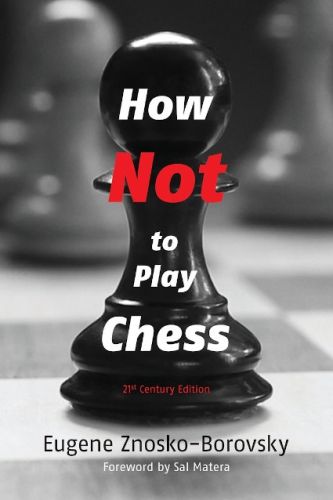
How Not to Play Chess
21st Century Edition
112 Seiten, kartoniert, Russell Enterprises, 1. Auflage 2025, original erschienen 1948
A Guiding Light for the Royal Game
Almost 100 years ago, one of the classics of chess literature was published in French. It was How Not to Play Chess by Eugene Znosko-Borovsky. It clearly and very simply set forth the basic principles of the game and was immediately embraced by chessplayers worldwide. That first edition originally in French was translated into many languages and became a staple of chess instruction everywhere.
However, it is not widely known that there were two more editions. The second edition was published in 1937. The final, third edition was released in 1948. Now, for the first time, this expanded third edition has been translated into English. Many diagrams have been added and algebraic notation is used.
The result is a brilliant manual for the modern generation of chessplayers.
Znosko-Borovsky, whom I consider one of the great chess teachers, explains the hard work and mindset required to improve your chess ability…The advice and wisdom he offers is relevant for both beginners and grandmasters. In truth, this book describes a process of study…I was delighted to reread How Not to Play Chess this time in a refreshing new translation of the third and final edition. Once again, the book energized me. I wish you all well on your chess journey and believe that this gem will act as a guiding light. From the Foreword by Sal Matera
About the Author
Eugene Znosko-Borovsky (1884-1954) was a Russian master who eventually settled in Paris. He enjoyed some success playing internationally. However, his main claim to fame in the chess world was as an instructor and author. His books were and still are considered some of the best instructional manuals ever written.
Almost 100 years ago, one of the classics of chess literature was published in French. It was How Not to Play Chess by Eugene Znosko-Borovsky. It clearly and very simply set forth the basic principles of the game and was immediately embraced by chessplayers worldwide. That first edition originally in French was translated into many languages and became a staple of chess instruction everywhere.
However, it is not widely known that there were two more editions. The second edition was published in 1937. The final, third edition was released in 1948. Now, for the first time, this expanded third edition has been translated into English. Many diagrams have been added and algebraic notation is used.
The result is a brilliant manual for the modern generation of chessplayers.
Znosko-Borovsky, whom I consider one of the great chess teachers, explains the hard work and mindset required to improve your chess ability…The advice and wisdom he offers is relevant for both beginners and grandmasters. In truth, this book describes a process of study…I was delighted to reread How Not to Play Chess this time in a refreshing new translation of the third and final edition. Once again, the book energized me. I wish you all well on your chess journey and believe that this gem will act as a guiding light. From the Foreword by Sal Matera
About the Author
Eugene Znosko-Borovsky (1884-1954) was a Russian master who eventually settled in Paris. He enjoyed some success playing internationally. However, his main claim to fame in the chess world was as an instructor and author. His books were and still are considered some of the best instructional manuals ever written.
| EAN | 9781963885125 |
|---|---|
| Gewicht | 160 g |
| Hersteller | Russell Enterprises |
| Breite | 15,2 cm |
| Höhe | 22,5 cm |
| Medium | Buch |
| Erscheinungsjahr | 2025 |
| Autor | Eugène Snosko-Borowsky |
| Sprache | Englisch |
| Auflage | 1 |
| ISBN-13 | 978-1-963885-12-5 |
| Jahr der Originalausgabe | 1948 |
| Seiten | 112 |
| Einband | kartoniert |
| Name | Russell Enterprises |
|---|---|
| Adresse | 234 Depot Road Milford, CT 06460 USA |
| Internet | www.Russell-Enterprises.com |
| hwr@russell-enterprises.com |
Verantwortlicher Importeuer:
| Name | Schachversand Niggemann |
|---|---|
| Adresse | Schadowstraße 5 48163 Münster Deutschland |
| info@schachversand.de | |
| Internet | www.schachversand.de |
Mehr von Russell Enterprises
-
 Nottingham 193624,95 €
 -
 Tal - Botvinnik 196019,95 €
 -
 Lasker's Manual of Chess29,50 €
 -
 Technique in Chess24,95 €
 -
 Mastering Mates 27,95 €
 - Mehr von Russell Enterprises